

Ocean Exploration Is Limited By
Article Abstract
The Roger Revelle Commemorative Lecture Series was created past the Sea Studies Board of the National Academies in honor of Roger Revelle to highlight the important links between ocean sciences and public policy. John O. Dabiri, the twenty-3rd almanac lecturer, spoke on April 28, 2022, at a virtual event hosted by the National Academy of Sciences.
Substantial efforts have been made to expand our cognition of the physics, biology, chemistry, and geography of the ocean using land-of-the-art measurement tools. With new global projects and technological advances, the collaborative efforts of the Bounding main Decade (2021–2030) are well on the style to revolutionizing our knowledge of ocean sciences and sustainability. Nonetheless fifty-fifty today, over three-quarters of the seafloor is withal unmapped, more than 90% of marine life still awaits discovery and classification, and the number of ocean sensors required to study global phenomena at sufficient temporal and spatial resolutions is seemingly intractable. To address this challenge, new approaches such as bio-inspired robotics can expand our existing toolbox and span this knowledge gap. The concept of biological science-inspired engineering has emerged as a powerful tool to complement traditional applied science approaches to engineering development. For example, specific swimming features of jellyfish and fish have been practical to a diverseness of fields, from vehicular propulsion to wind energy to medical diagnostics. In detail, jellyfish are advantageous model organisms considering of their energy efficiency, with the everyman known toll of ship compared to other animals, every bit well as their ubiquity and survivability in various ocean environments. In this commodity nosotros highlight the development of research into jellyfish-inspired robotic constructs and their potential applications in ocean exploration. Later initial projects using entirely engineered materials (i.e., jellyfish-inspired submarine propellers) and tissue engineering methods (i.eastward., rat cardiac cells seeded on flexible films), recent work to integrate microelectronic systems onto alive jellyfish demonstrates that their swimming speeds can exist increased (up to three times compared to their baselines) and their free energy efficiency can be improved (up to four times compared to their baselines). This shows hope for the robotic control of jellyfish in real-world oceanic environments, where the animals are already distributed globally. Future work can improve the maneuverability of these bio-hybrid jellyfish robots, incorporate miniaturized sensors to profile regions of interest, and ultimately deploy swarms of these low-ability, depression-price robots to obtain high-resolution data and amend sea climate models. The synergy of bio-inspired technologies with existing bounding main measurement tools holds promise to push button the frontiers of ocean exploration and stewardship.
Full Text
Motivation
The Roger Revelle Commemorative Lecture provides a unique opportunity to share an ongoing, decade-long journey toward the goal of biology-inspired ocean exploration, a concept nosotros introduce in this commodity. The ocean is, in many regards, Earth'south final frontier, and its exploration presents an attraction that no doubt as well called to Roger Revelle himself, as he dedicated much of his career to furthering oceanographic research and studying climate change.
From working at the Scripps Institution of Oceanography to serving on the Scientific Committee on Oceanic Research (SCOR)—among a multitude of other leadership roles in academia and policy—Revelle demonstrated a fundamental commitment to expanding our knowledge of the ocean. His dedication to both basic and applied research led to advancements on international scales, and in detail, to the introduction of the concept of climate modify through studies of the chemical makeup of the bounding main. The "Revelle cistron," defined equally the ratio of instantaneous carbon dioxide (CO2) and full dissolved inorganic carbon (Broecker et al., 1979), is a metric of the bounding main's absorption of atmospheric CO2 that is still actively used, among other buffer factors, in biogeochemical inquiry for tracking the chemical science of the bounding main (Egleston et al., 2010; Cai et al., 2020; Humphreys et al., 2022). In fact, Revelle'due south work with Hans Suess regarding atmospheric COtwo and dissolved inorganic carbon led to the outset reported use of the term "global warming" (Revelle and Suess, 1957). Now known by some as the "begetter of global warming," Revelle conducted studies measuring climate change, spoke nearly potential anthropogenic causes, and chaired formal written report groups, such equally the Committee on Climate Change and the Ocean (CCCO) within SCOR and the Intergovernmental Oceanographic Committee of the United Nations Educational, Scientific, and Cultural Organization (IOC-UNESCO; Sabine et al., 2010).
To fully capeesh the significance of these studies of the ocean and associated climate change impacts, we must remember that the bounding main represents approximately 99% of the habitable volume on Globe (NASA Scientific discipline: Share the Science, 2022), and information technology is estimated to serve equally home to over two million unlike species of organisms (Mora et al., 2011). In improver to its circuitous ecosystems that host a wealth of biodiversity, the ocean is recognized as a primary lever of climatic change, for example, via its ability to sequester carbon (DeVries et al., 2019). And, in terms of the world economic system, up to 6 trillion USD per year tin exist attributed to the ocean—through shipping, fisheries, energy, tourism, and a variety of other economic activities (Gillsater, 2018)—with over 90% of global trade reliant on body of water routes (OECD, 2020). Furthermore, sea-based industries disproportionately touch developing countries, with half-dozen marine industries contributing to over 11% of the gross domestic product (GDP) in lower middle-income countries and half-dozen% in low-income countries, compared to less than 2% in loftier-income countries and members of the Organization for Economic Co-functioning and Development (OECD). In some low-income countries and small isle developing states, ocean-based industries deemed for over 20% (OECD, 2020). On these bases alone, information technology is non an overstatement that the future of life on Earth depends on sustainable ocean stewardship.
And nonetheless, by multiple measures, the ocean remains relatively poorly studied and relatively poorly understood. What nosotros do know is quite literally a drop in the ocean. Quantifying this knowledge gap is challenging a priori, but it can exist illustrated by comparing our knowledge of ocean bathymetry (i.e., topological studies of the ocean floor and seabed structures) to our knowledge of the structure and dynamics of other planets. Today, approximately ten%–15% of the seafloor has been mapped at 100 m resolution, as compared to 100% of our neighboring planets Mars and Venus (Copley, 2014). To support the endeavor of ocean mapping here on Earth, in 2017 The Nippon Foundation and the General Bathymetric Chart of the Oceans (GEBCO) Seabed 2030 Project began an endeavour to map the entire ocean floor, as part of the Un (Un) Decade of Bounding main Science for Sustainable Development (2021–2030; https://world wide web.oceandecade.org/). Compared to the GEBCO grid map in 2021, an boosted 2.eight% of the ocean flooring has been mapped, bringing the estimate of the full seafloor mapped to 23.4% in 2022, ranging from 100 m to 800 m grid sizes (https://seabed2030.org/mapping-progress). However, the disparity with our cognition of neighboring planets becomes fifty-fifty more dramatic if we consider smaller length scales, such as ane m resolution. These are scales at which many important biological phenomena occur in the bounding main, and yet, less than one-tenth of one percent of the seafloor has been mapped at that resolution (Mayer et al., 2018), although there are ongoing efforts through bathymetric surveys (Fregoso and Jaffe, 2020) and oversupply-sourcing (Novaczek et al., 2019).
Bated from seafloor mapping, the majority of mid-water regions—approximately one billion cubic kilometers of the sea—also remain unsampled, with estimates that up to 90% of species biodiversity in the ocean still remains unstudied (Reaka-Kudla, 2001). To date, approximately 240,000 marine species have been catalogued by experts as "accepted marine species" in the World Register of Marine Species (WoRMS Editorial Board, 2022). Moreover, because ocean water masses are not static, sampling a given region once is likely insufficient to claim a comprehensive understanding of that region of our temporally evolving sea. With a multitude of such confounding factors, it is difficult to determine how ocean environments develop naturally, also as to quantify potential anthropogenic forces and their furnishings. In sum, the Un Sea Decade faces many challenges (NASEM, 2022).
Existing Tools for Sea Exploration
To exist sure, a suite of increasingly powerful measurement tools has avant-garde body of water exploration and ocean scientific discipline over the past several decades. Figure 1a provides examples, from aerial to surface to subsea tools; additional systems are in development and coming online each twelvemonth. In examining the effigy, note the bias of our measurement tools toward the ocean surface. To begin, remote sensing of the ocean uses sensor technologies on satellites and aeriform vehicles. These sensors measure physical characteristics, such equally spectral radiance, to assess h2o turbidity, concentrations of phytoplankton, body of water surface temperatures and topography, and wave interactions with bounding main ice (Chapron et al., 2008; Kavanaugh et al., 2021; Collard et al., 2022). Resulting satellite images can exist used to map ocean characteristics like phytoplankton blooms. Although remote-sensing data from technologies such every bit radar or radiometers tin can offer valuable synoptic measurements across large spatial areas and over relatively long time periods, optical properties of seawater constituents (due east.1000., absorption and handful across different wavelengths) limit the water depth to which satellites can provide useful information.
In contrast, in situ ocean measurements take advantage of tools and sensors that collaborate straight with surface and subsea environments. Surface vessels have served as a primary tool for body of water scientific discipline for well over a century. Now, to address efforts toward mapping the entire seafloor, autonomous surface vehicles (ASVs) and other surface and subsea measurements are collecting bathymetric information with increased spatial and temporal resolutions ( Effigy 1b ). Furthermore, by deploying instruments such as conductivity-temperature-depth (CTD) probes, it is possible to record the bounding main's salinity and temperature at total depth in many regions of the earth. However, it has been estimated that it would require 200 ship-years to sample the entire sea at merely i depth, that is, a single ship moving through the ocean for 200 years, or a armada of 200 ships, all working in concert for a whole year—just to measure out one depth in the ocean (NRC, 1959). In addition to the prohibitive expense of such an endeavor, the dynamic nature of the ocean means that an initial series of measurements might be rendered obsolete by the time a campaign to measure the entirety of a single depth of the ocean had concluded. Therefore, although surface stations, ships, and buoys provide in-depth data for single locations, these tools are limited in their potential to calibration to global body of water coverage.
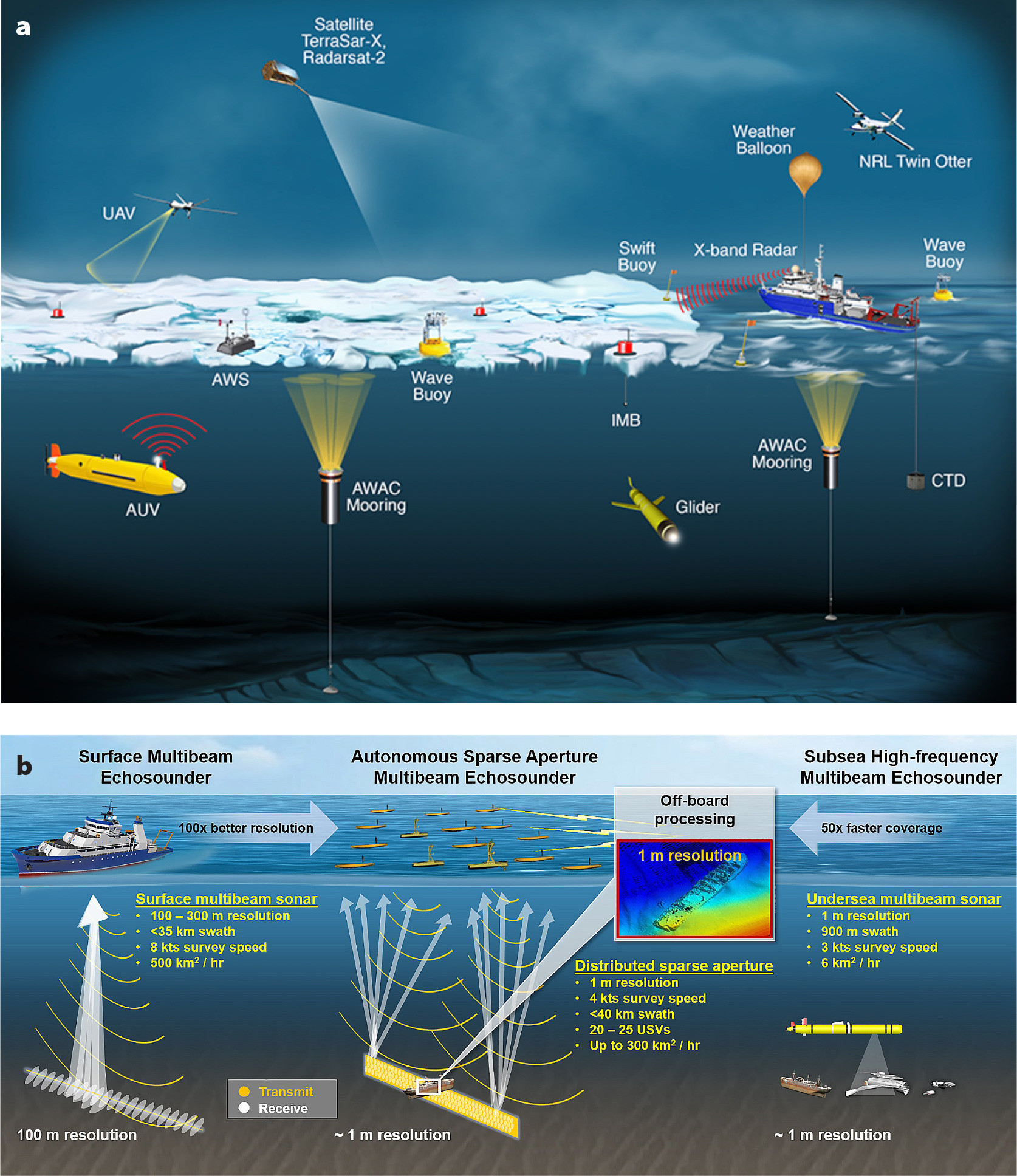
Figure 1. (a) Examples of existing tools for studying the bounding main, which include imaging radar satellites (i.e., TerraSar-X, Radarsat-2), unmanned aerial vehicles (UAVs), utility aircraft (UV-18 Twin Otter), conditions balloons released from ships, Surface Moving ridge Instrument Float with Tracking (SWIFT) buoys, wave buoys, ice mass balance (IMB) buoys, automatic weather stations (AWS), autonomous underwater vehicles (AUVs), acoustic moving ridge and current stations (AWAC), gliders, and send-based instrumentation such equally conductivity-temperature-depth (CTD) instruments. From Thomson et al. (2017) (b) Comparison of three approaches for measuring bathymetry at higher resolutions with faster coverage using multibeam sonar. Adapted from the Lincoln Laboratory at the Massachusetts Establish of Technology. > Loftier res figure
Nevertheless, significant progress has been made with efforts using drifters, notably the Biogeochemical-Argo programme (BGC-Argo; Biogeochemical-Argo Planning Grouping, 2016), an extension of the parent Argo program (Roemmich et al., 2009). In improver to profiling the temperature, salinity, and pressure down to 2,000 m depth equally do Argo floats, BGC-Argo collects profiles of oxygen, nitrate, pH, chlorophyll a, suspended particles, and downwelling irradiance (Claustre et al., 2020).
A complementary approach to drifters and ship-based measurements is the employ of distributed autonomous underwater vehicles (AUVs), untethered systems with onboard power, propulsion, and sensors that operate without real-time input from human operators. These systems are not express to traversing the ocean surface, just they are typically express in mission duration due to free energy requirements for propulsion, usually from propeller and thruster units (Steele et al., 2009). Current methods of charging AUVs include battery swapping, solar charging, and wired and wireless underwater charging techniques. These generally crave that AUVs surface or that personnel manually switch batteries, with the potential take a chance of exposing electronics to seawater, although recent work is addressing this challenge by using inductive wireless power transfer (IWPT; Teeneti et al., 2021).
Buoyancy- and wave-driven gliders provide another pick for sea exploration with enhanced endurance. These systems can be much more energy efficient than propulsor-based AUVs through use of ballasted pump systems to drive horizontal motion, thus allowing mission durations across a full year. Even so, the more limited maneuvering ability of gliders tin can inhibit their use almost complex seafloor topography (Folio et al., 2017). In addition, when the objective is to track naturally occurring biological phenomena in the ocean, the inability of gliders to maintain station without triggering animate being avoidance behaviors can create an impediment for studies of biological oceanography.
Additionally, while the costs of existing ocean technologies continue to decline as the associated technologies become more widely available in other commercial sectors, they remain a significant fiscal investment. For example, each BGC-Argo float costs 100,000 USD for an operational lifetime of four years, and current estimates suggest that an array of ane,000 floats is needed to obtain sufficient information resolution to improve understand global biogeochemical processes (Biogeochemical-Argo Planning Group, 2016). Typical cost estimates for propeller-driven AUVs get-go upwardly from 50,000 USD, with vehicle maintenance and operational costs resulting in thousands of boosted dollars per operating twenty-four hours (Gish, 2004). A unmarried large AUV tin cost upward to 6 million USD (Claydon, 2006), which is prohibitively expensive to scale to millions of systems. To this finish, both commercial and regime agencies have dedicated research focuses to edifice more advanced, cost-effective, and persistent AUVs inside the next v to 10 years, ranging from small, portable models to extra-large vehicles such as the Orca Extra Large Unmanned Undersea Vehicle (XLUUV) for various ocean applications (O'Rourke, 2022).
To be sure, the premise that millions of oceangoing underwater systems are truly necessary for comprehensive (i.e., concurrent and global) body of water exploration requires justification. Retrieve that the volume of sea water is roughly 1 billion cubic kilometers. A uniformly distributed array of one 1000000 measurement systems would therefore each still be tasked with monitoring an area equal to the size of the city of Los Angeles in the United States (ane,000 kmii) and throughout a depth of i kilometer of the ocean. By this thought practice, it becomes apparent that fifty-fifty i 1000000 sensors would likely be a significant underestimate for the job at hand. It also underscores the vastness of our ocean. Thus, in addition to further developing the tools described above, new technologies are needed to expand our sea measurement capabilities and provide information at spatial and temporal scales relevant to bounding main science.
A Solution Inspired past Biological Locomotion
One method of creating new bounding main technologies is to expect to nature for guidance. Past using biological principles, we can take reward of designs that accept already been honed through millions of years of evolutionary pressure and, with fewer biological constraints such every bit evolutionary fettle, potentially meliorate upon natural designs. Thus, over the past decade, we have explored solutions for ocean exploration that are inspired by the swimming capabilities of many body of water organisms.
Previous research has demonstrated the power of bio-inspired engineering to achieve meaning advances in fields every bit diverse as submarine vehicle design using principles of biological jet propulsion (Ruiz et al., 2011; Whittlesey and Dabiri, 2013), wind energy based on fish schooling behaviors (Whittlesey et al., 2010; Dabiri, 2011), and biomedical diagnostics using flow construction analogues with cardiovascular medicine (Dabiri and Gharib, 2005; Gharib et al., 2006). In the present instance regarding underwater vehicles for ocean applications, an important hint regarding the potential for biological inspiration lies in consideration of a functioning metric chosen the price of transport (COT). This is the energy expended by an organism per unit mass and per distance traveled (i.e., joules per kilogram per meter), which can be considered as the inverse of more traditional efficiency metrics for vehicles, such as propulsive efficiency or fuel economy (i.e., miles per gallon or MPG). Thus, while a more energy efficient motorcar offers higher MPG, a more than free energy efficient animal exhibits lower COT. Another difference between the COT and more traditional efficiency metrics is the consideration of metabolic costs in COT, which can contribute to lower COT values in some animal species. Effigy 2a illustrates COT versus mass for a variety of animals, as well as a representative small AUV (REMUS 100) for comparison. Note that the axes in Figure 2a are scaled logarithmically, which visually diminishes the disparity in the numbers. To underscore this signal, Figure 2b visualizes the difference between logarithmic and linear scales. To be certain, the comparison between animals and engineered vehicles is imperfect, as the mass associated with locomotion in organisms is not necessarily that associated with hydrostatic rest in vehicles. Indeed, the dynamics of locomotion at abiding velocity are independent of mass (see Newton's second police force). All the same, for the purpose of lodge-of-magnitude comparison, Figure two illustrates the point that the energy efficiency of biological locomotion is competitive with—and may significantly exceed—the efficiency of existing engineering systems.
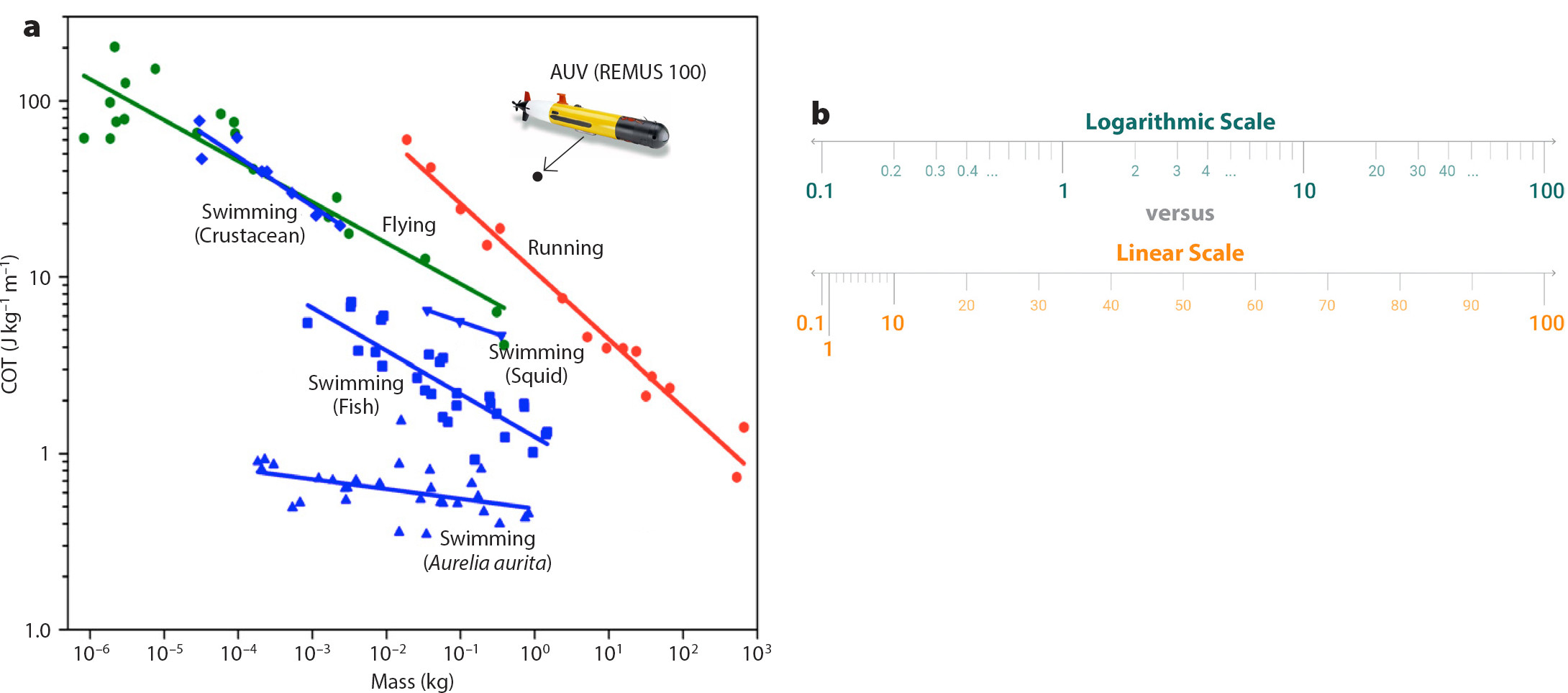
FIGURE 2. (a) Cost of transport (COT) versus mass for a variety of animals (colored by mode of locomotion, with pond in blue, flying in green, and running in blood-red) and a representative AUV (e.1000., REMUS 100). Note that both axes are scaled logarithmically, and as illustrated, Aurelia aurita jellyfish possess the lowest COT values equally the most energy efficient animals. Adjusted from Gemmell et al. (2013) (b) A schematic scale showing the difference between a logarithmic scale (light-green) versus a linear scale (orange), to highlight the disparity in the COT values in the top logarithmic plot. Adapted from Lisa C. Muth, Datawrapper. > High res figure
This potential is most striking for jellyfish, organisms with the lowest known COT of all metazoans (Gemmell et al., 2013). Therefore, our initial challenge is to empathise the dynamics of jellyfish pond, with the goal of incorporating those design principles into engineered vehicles. Success could enable scaling of ocean sensors to swarms of millions, circumventing the energetic constraints that present a bottleneck for scaling existing engineered vehicles for whole-sea exploration.
Uncovering the Hydrodynamics of Jellyfish Swimming
Jellyfish present unique challenges for the report of their swimming biomechanics. In many cases, the gelatinous organisms are as well fragile to capture and bring into a laboratory environment (a limitation that further highlights the sampling bias of some ship-based measurement techniques). In addition, experiments in circulating laboratory water tunnels, known equally pseudokreisels, designed with rounded corners and abiding catamenia atmospheric condition, may non replicate the hydrodynamic stimuli that jellyfish see in their natural habitats (Purcell et al., 2013).
To address these challenges, we collaborated with colleagues to develop new in situ flow measurement techniques. By illuminating suspended particulates in the water cavalcade with lasers, and tracking particulate motion using high-speed videography, the new technique—a self-contained underwater velocimetry apparatus, or SCUVA (Katija and Dabiri, 2008; Katija et al., 2011)—enables divers to record the fluid dynamics of jellyfish swimming in the ocean ( Effigy 3 ).
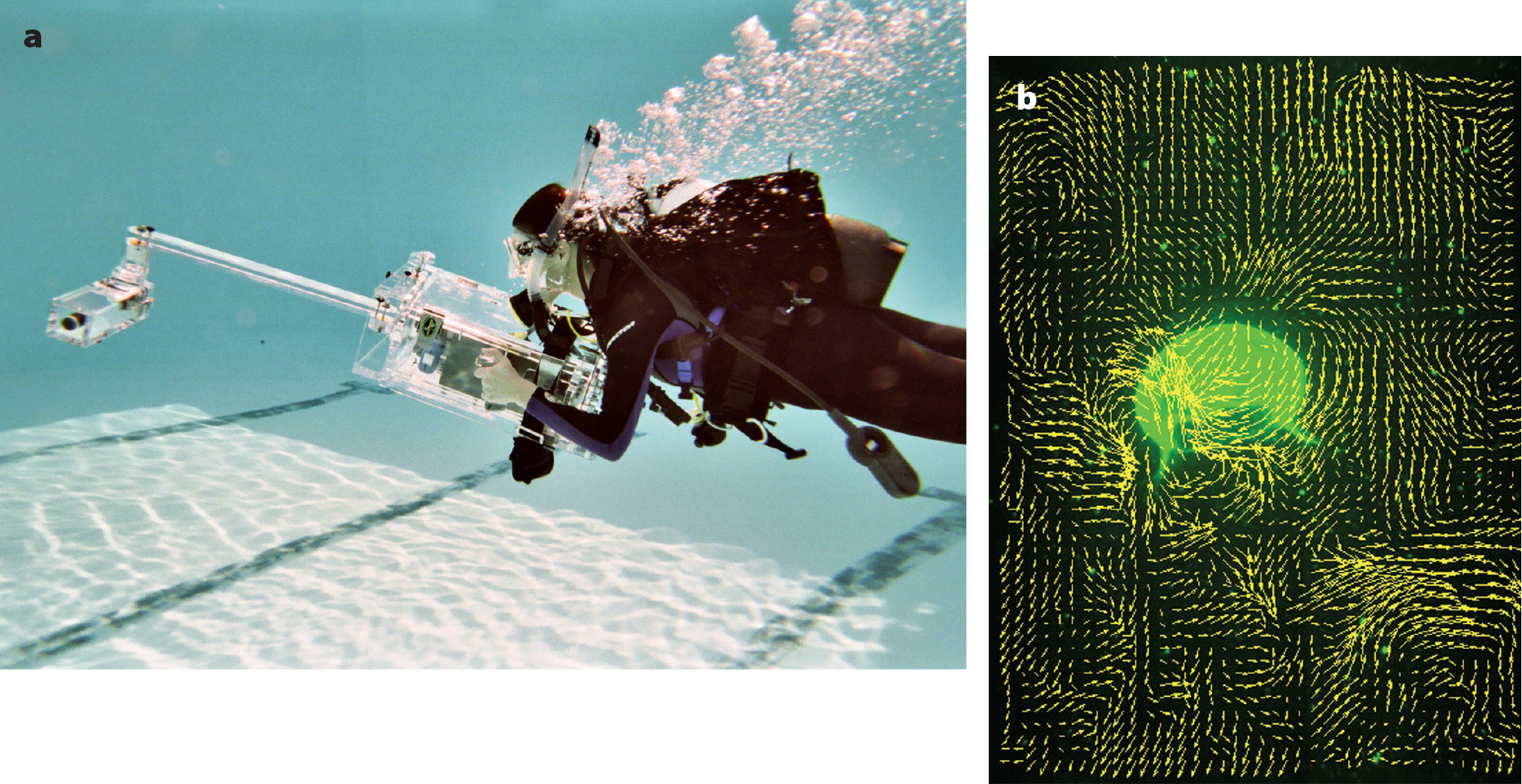
FIGURE 3. (a) Working in a pond pool as a demonstration before deployment, a diver operates a self-contained underwater velocimetry apparatus (SCUVA), comprising a high-speed photographic camera connected by a retractable arm to a laser source that allows visualization of the flow fields around animals in their natural habitats. (b) An example epitome of a measured velocity field (yellow vectors) around an Aurelia jellyfish swimming in Long Beach, California, demonstrates the capabilities of SCUVA. > High res figure
This new, quantitative perspective revealed three fundamental mechanisms that contribute to the high energetic efficiency of jellyfish pond. First, the periodic contraction and relaxation of the umbrella-shaped jellyfish trunk or bell creates vortex rings, toroidal (i.east., donut-shaped) swirling water currents, in an animal's wake. During the contraction stage of swimming, the jellyfish bong activates a monolayer of muscle, oriented in a ring on the subumbrellar surface, to squirt the volume of water under the body's cavity, resulting in the shedding of "starting" vortex rings. These starting vortices entrain surrounding h2o as they abound, enabling the animals to transfer momentum to the fluid (i.e., generate thrust) with less free energy expenditure than that associated with the conventional jet propulsion of a rocket (Dabiri, 2009).
2d, during the relaxation phase of swimming when the brute recovers to its resting body shape and water refills the subumbrellar volume, a second vortex ring of contrary rotational sense is formed upstream of the starting vortex shed. The germination of this "stopping" vortex, enhanced by the bell refilling stage, generates a secondary h2o current behind the animate being that continues to push it forward even as it recovers from its initial swimming wrinkle. In fact, although starting vortices exhibit peak velocities during the contraction phase, the maximum circulation of stopping vortices can exceed the circulation of starting vortices, which underscores the influence of the stopping vortex over the entire swim cycle. Furthermore, the formation of this stopping vortex draws on the stored strain free energy of the mesoglea (i.e., the gelatinous fabric that forms the majority of the jellyfish bong) via rubberband tissue properties. Therefore, this process of passive energy recapture during the passive phase of jellyfish swimming allows the animals to swim 30% farther per bicycle without additional energy input from the muscles. This contributes a 48% comeback in the COT for jellyfish (Gemmell et al., 2013).
Finally, using the water velocity measurements to infer the corresponding water pressure (Dabiri et al., 2014), we discovered that subtle body bending during swimming generates big anterior regions of depression pressure on the animal trunk. Using minute radial musculus contractions at the bong margin to enhance bending, the animals are effectively "sucked" forward into low-pressure regions toward the exumbrellar surface, thereby further reducing their energy cost (Gemmell et al., 2015). Together, these three physical mechanisms contribute to the highly efficient locomotion of jellyfish (Costello et al., 2021). The challenge that remains is to leverage this new knowledge for the design of bio-inspired propulsion technologies.
Replicating Jellyfish Pond Performance
Given our improved scientific understanding of the mechanisms leading to efficient jellyfish locomotion, the applied science charge is to blueprint an underh2o system that exploits those physical phenomena. A natural temptation is to simply mimic the shape and swimming kinematics of existent jellyfish via robotic analogs. However, as all the same, no engineered materials exhibit the same actuation and flexibility of the fauna tissue, and fifty-fifty materials used in soft robotics—such equally EcoFlex (Young's modulus of 0.1 MPa), Sylgard (1.3–3.0 MPa), and gelatin-glycerol mixes (0.7–2.7 MPa) (Shintake et al., 2017)—are orders of magnitude stiffer than the rubberband properties of jellyfish mesoglea (Immature's modulus of 340 Pa in 1 species of hydromedusae; Megill et al., 2005). Efforts to estimate jellyfish locomotion using existing applied science materials have successfully replicated their pond motions, only with significantly higher energy costs of transport (Villanueva et al., 2011; Gemmell et al., 2013; Frame et al., 2018).
Our initial efforts focused on a strategy that leveraged existing propeller-driven vehicle platforms; one example of a modified vehicle design is shown in Effigy 4 . The blueprint concept aimed to combine the high mechanical efficiency of the propeller with the high hydrodynamic efficiency of vortex ring formation. Specifically, the catamenia inlets to a shrouded propeller were designed to periodically open and close during operation. When toggled at high frequency, this periodic throttling generated vortex rings in the wake similar to those created past swimming jellyfish ( Figure 4 ).
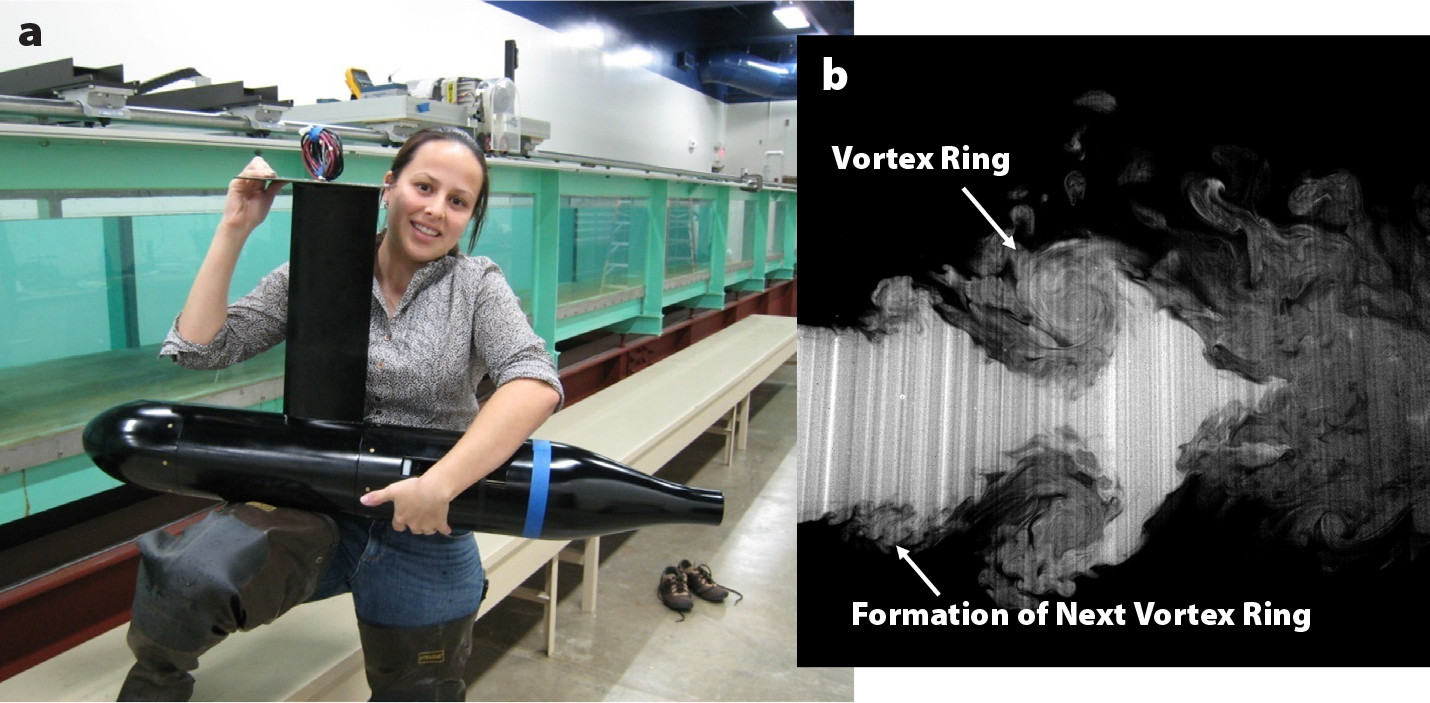
Figure 4. (a) Lateral flow inlets that lead to a shrouded propeller in this bio-inspired underwater vehicle periodically open up and close to generate vortices. (b) A dye visualization of the vehicle wake reveals vortex ring formations. Menses is left to right. From Ruiz et al. (2011). > High res figure
Measurements of the vehicle'southward operation in a twoscore 1000 long h2o channel demonstrated significant increases in hydrodynamic efficiency at all speeds tested, from x cm to 60 cm per second. In an intermediate range of speeds, the increases approached twoscore% over the efficiency of baseline, steady propeller operation (Ruiz et al., 2011). However, this increased hydrodynamic functioning was ofttimes offset past reduced mechanical efficiency. In other words, the additional energy lost in the machinery that created unsteadiness could exceed the hydrodynamic benefits from vortex band formation.
Recognizing the limitations of engineering actuators, nosotros later explored the feasibility of using biological actuators—live muscle cells—to power the engineered swimming robots, in much the same way that jellyfish use their ain muscles to swim. Live muscle has the reward of being multifunctional. The tissue provides the necessary actuation to set the surrounding h2o into move. It too provides structural scaffolding, and it can heal itself if damaged. In addition, different engineered, mechanical systems, the muscle tissue provides chemical energy storage, and it facilitates direct chemical energy conversion, as opposed to indirect conversion from a battery to a motor, and then through gearing to the ultimate trunk motion. This work leveraged muscular thin film technology pioneered by collaborators at Harvard University that is based on cardiomyocytes (i.east., cardiac cells) extracted from rats (Feinberg et al., 2007).
By leveraging these recently developed tissue engineering science techniques, rat cardiac cells were seeded onto silicon platforms and driven by external electric fields to incite their contractile motility. As shown in Effigy 5 , information technology was possible to replicate the details of the muscle architecture down to the micron scale. The resulting bio-inspired swimmers proved effective at replicating natural beast pond move and fluid dynamics (Nawroth et al., 2012). While this work demonstrated a paradigm of bio-hybrid robots that has subsequently been adopted for other pond and crawling organisms (i.e., a biohybrid fish; Lee et al., 2022), its use for ocean exploration is limited in practice by the live tissue, which only remains viable in specific aqueous media (i.e., Tyrode's solution). Hence, the bio-hybrid robotic swimmers are express to laboratory environments. Additionally, the scale of these swimmers is currently limited to approximately one centimeter in diameter, and scaling the size upward could be nontrivial. Nonetheless, these bio-hybrid tissue engineered constructs provide a valuable platform for studying efficient bio-inspired locomotion and provide further insight into bioengineering techniques for medical applications, such every bit the potential for seeding human cardiomyocytes in more than complex, bio-compatible scaffolding structures to grow artificial organs for transplant patients, among other ambitious goals. Moreover, the cognition gained from these studies led to our ultimate strategy to expand the toolset of bio-inspired ocean exploration.
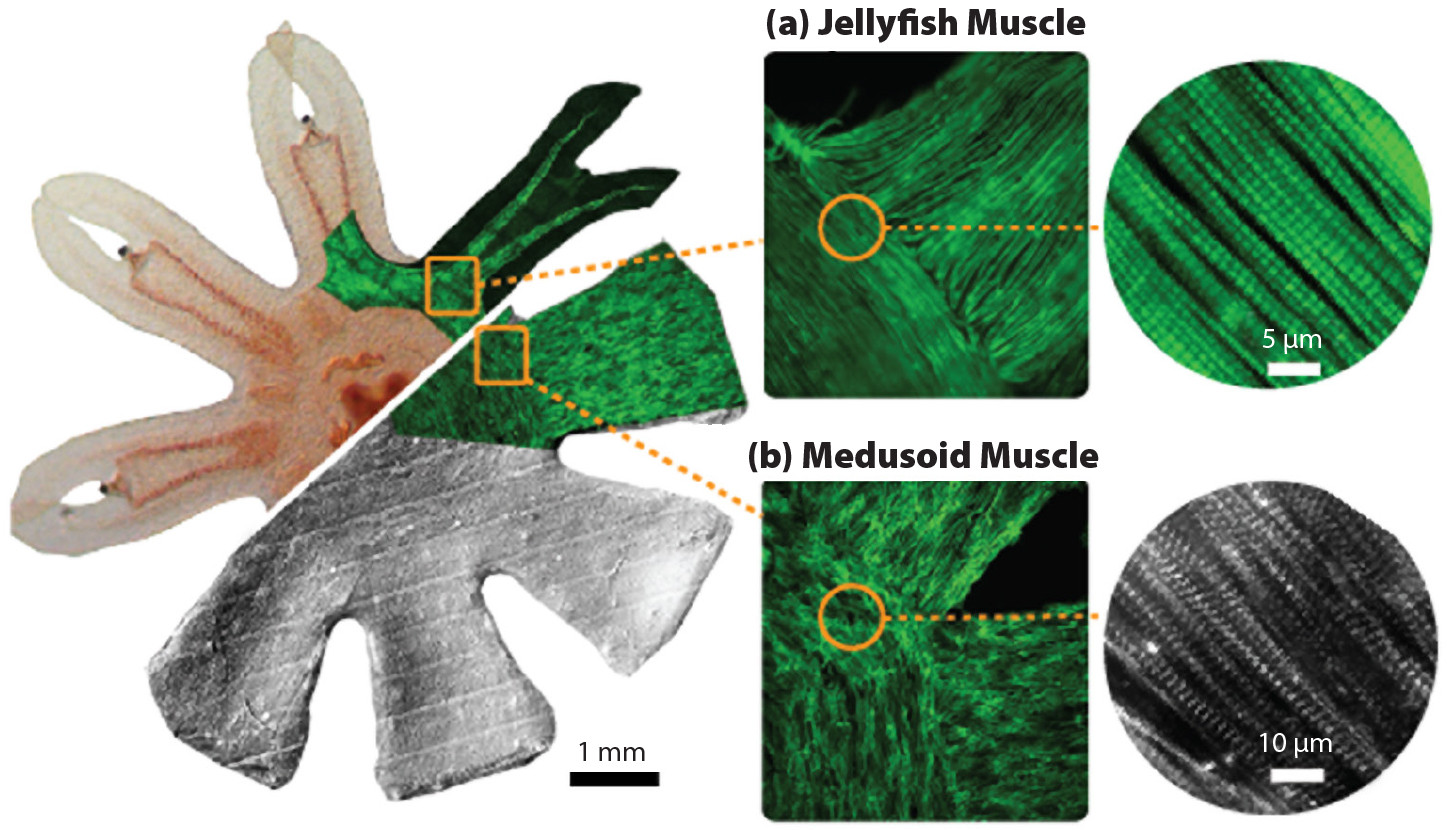
FIGURE v. Multi-scale comparison of the muscle architecture of (a) a existent jellyfish and (b) a bio-inspired, tissue engineering construct. From Nawroth et al. (2012). > Loftier res figure
Remotely Controlled Jellyfish
Our scientific journey led us to the realization that global sea exploration might be most effectively achieved past jellyfish themselves. This strategy takes advantage of the efficient hydrodynamics and actuation that already occur naturally in the sea. Jellyfish are self-powered by feeding on prey inside the water column. They are naturally cocky-healing. They exhibit neither latitude nor depth limitations in the ocean, even thriving in hypoxic regions and climate change induced extreme weather condition to which many other species cannot arrange. Their operation at depth is particularly important, given that we already take an excellent set up of tools for studying the upper body of water ( Figure one ). The pressure of the deep sea, combined with our inability to probe it from the surface using most traditional technologies, has made that function of the ocean nearly impenetrable for prolonged temporal observations at any spatial calibration. In part considering they practise not possess a swim float, jellyfish tin be found as deep equally the Marianas Trench, at least 3,700 chiliad beneath the ocean surface (Brooke et al., 2017). While accompanying sensors would still require hardening to endure pressures at those depths, that task can be more than tractable than hardening an entire AUV to withstand the high pressure in the deep ocean while likewise remaining sufficiently small every bit to part with an efficient propulsion system. Finally, the utilise of bio-inspired robotics using animals, with their more than natural acoustic and wake signatures, tin can potentially allow for closer studies of the flora and beast in environmentally sensitive regions that might otherwise be impacted by traditional vehicular noise signatures. Thus, ane approach for ocean monitoring is to use remotely controlled jellyfish, or bio-hybrid robotic jellyfish. But to accost the integration of a robotic system onto alive jellyfish, we must outset consider several ethical and logistical questions.
Ethical Considerations
It is important to address the ethics of this approach preemptively. To augment these animals, nosotros aim to "steer" the jellyfish using electronics, analogous to the control of farm animals for agriculture. To be sure, fifty-fifty the concept of electronic stimulation of the neuromuscular arrangement has been well established. Such stimulation is the cadre of artificial cardiac pacemakers, transcutaneous electrical nerve stimulation (TENS), dry needling, and other forms of concrete therapies for medical treatment and intervention with minimal pain or discomfort to the patient. Robotic stimulation of fretfulness and muscles tin can therefore utilize more broadly to different species of jellyfish, aquatic invertebrates, and other marine animals (with farther consideration toward animal ethics).
Such ethical considerations are not lilliputian, fifty-fifty amongst higher order invertebrates (De Waal and Andrews, 2022). In the case of jellyfish, a lower club invertebrate with distributed nerve nets, we note their lack of a central nervous system and of nociceptors, or hurting receptors, which makes them good candidates as subjects for animal research. Although hurting is a subjective experience, nociception is an objective physiological response to stimuli (Sneddon, 2018). Considering jellyfish do not take either central nervous systems or nociceptors, other proxies tin be used instead, in line with the precautionary principle, to minimize fifty-fifty potential impairment or distress to subjects (Birch, 2017). While the species of jellyfish used in this research, Aurelia aurita, can exhibit indicators of stress under some environmental stimuli (east.g., excretion of mucus), no such response has been observed using the techniques implemented presently. Furthermore, once the swim controllers were removed from the animals, their behaviors returned to baseline conditions, including swimming, feeding, and reproducing in the laboratory. Reproduction, in particular, can be negatively impacted by compounding stressors, and producing offspring even throughout laboratory tests is an indicator of animal well-being.
In addition to the upstanding considerations of the individually augmented animals, we too consider the broader environmental ethics of deploying bio-hybrid robotic jellyfish in ocean environments. Kickoff, care should be taken to ensure that the jellyfish species used in specific regions of the bounding main are endemic so they do not become invasive species. To be certain, many jellyfish species, both endemic and invasive, have get more problematic because of their increased survivability under changing environmental factors, such equally increased ocean temperatures and acidities, compared to other metazoans in the ecosystem. To counter these furnishings, jellyfish should be captured, instrumented, and released only from their natural environments. Moreover, future inquiry enabled by the remote control of jellyfish could be used to better understand the origin of loftier evolutionary fitness in jellyfish and their robust survival tactics.
For our field experiments, we used species endemic to the region and closely monitored the private animals to forbid them from escaping or coming to harm, equally well as to ensure that no plastic or electronic byproducts were discarded in the ocean. For an expanded future research program, an important consideration is the potential introduction of waste product into the sea from deployment of big numbers of bio-hybrid robotic jellyfish. Because jellyfish are consumed by some natural predators, it is feasible that a predator could incidentally ingest a robotically stimulated jellyfish that has been deployed for more remote or autonomous ocean expeditions, where they remain unmonitored or where human monitors are unable to intervene. For upstanding purposes, the environmental impacts can be minimized past using more than natural or biodegradable materials for the electronic components, sensors, and housing elements (Irimia-Vladu et al., 2012). For scientific purposes, the use of multiple jellyfish as swarms to plan for data loss is central, although real-fourth dimension data collection methods would be platonic to obtain sensor information earlier the jellyfish are offline.
These upstanding considerations will be continuously revisited every bit the work progresses and becomes more than imminent. We have collaborated with bioethicists to ensure that we apply a well-informed framework to considerations of whatever new inquiry in this area, with attention toward individual animals, jellyfish as a species, and potential environmental and ecological furnishings (Xu et al., 2022).
Robotic Implementation
For robotic control, the choice of using this species of jellyfish goes beyond the simplicity of their bodies and nervous systems for ethical considerations. Aurelia aurita, or moon jellyfish, the most common species of jellyfish, are plant in a wide range of natural environments. Furthermore, they are the most widely studied jellyfish species, and they offering practical advantages for laboratory experiments because of their ease of care in artificial environments and lack of harm to humans. Although they practice possess nematocysts, their stinging cells cannot penetrate homo skin. Furthermore, the jellyfish used in this research can exist obtained from those bred in captivity, where generations of breeding and a lack of contest for food have farther decreased the capabilities of their stingers to inflict injury to human handlers.
To control jellyfish pond, small microelectronics are embedded in the body tissue. The microcontroller and battery system are placed in the center of the bell where at that place is nearly tissue mass, and electrodes are located near the bell margin to innervate the muscle band directly ( Figure 6 ). The components necessary for a complete system are commercially available at very low toll; a control module tin can be assembled for a few dollars, with decreasing costs as the process scales toward mass production. This cost advantage can enable the present approach to scale to millions of devices, equally the animals themselves can be mass-produced past asexual reproduction for simply minimal animate being care costs. Regarding human being labor to insert the robotic organisation into the animal, the insertion process is also quick, requiring less than a few seconds per fauna. Thus, the cardinal question is to assess the swimming performance of the robotically controlled jellyfish.
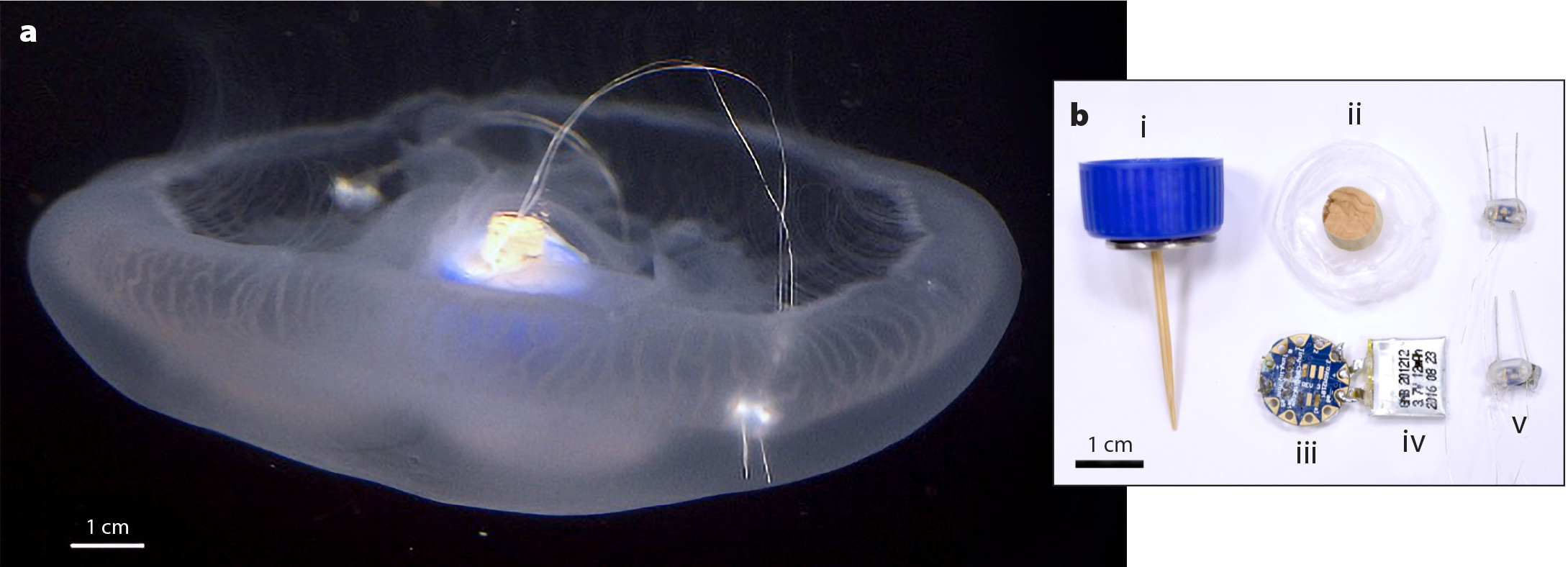
FIGURE 6. (a) Photograph of Aurelia jellyfish with electrodes implanted at its margins and a microcontroller located at its middle. (b) Swim controller components: (i) waterproof housing and attachment pin, (ii) plastic film sealant, (iii) TinyLily miniprocessor, (iv) lithium polymer battery, and (v) platinum electrodes with LED indicators. From Xu and Dabiri (2020). > High res figure
Figure 7 compares the swimming speed of the externally controlled jellies to that of jellyfish swimming nether endogenous control, without the influence of the swim controller (but with the swim controller implanted), nether laboratory conditions in the absence of menses. The robotically controlled jellies swim upwardly to three times faster than natural jellyfish. We attribute this to the more regular swimming of the externally controlled jellies, too as the fact that they can be induced to contract at faster frequencies than they exhibit naturally. Hydrodynamic models as well indicate that specific jellyfish morphologies (such as more prolate bell shapes) can be chosen to obtain more than enhanced swimming speeds for future robotic control.
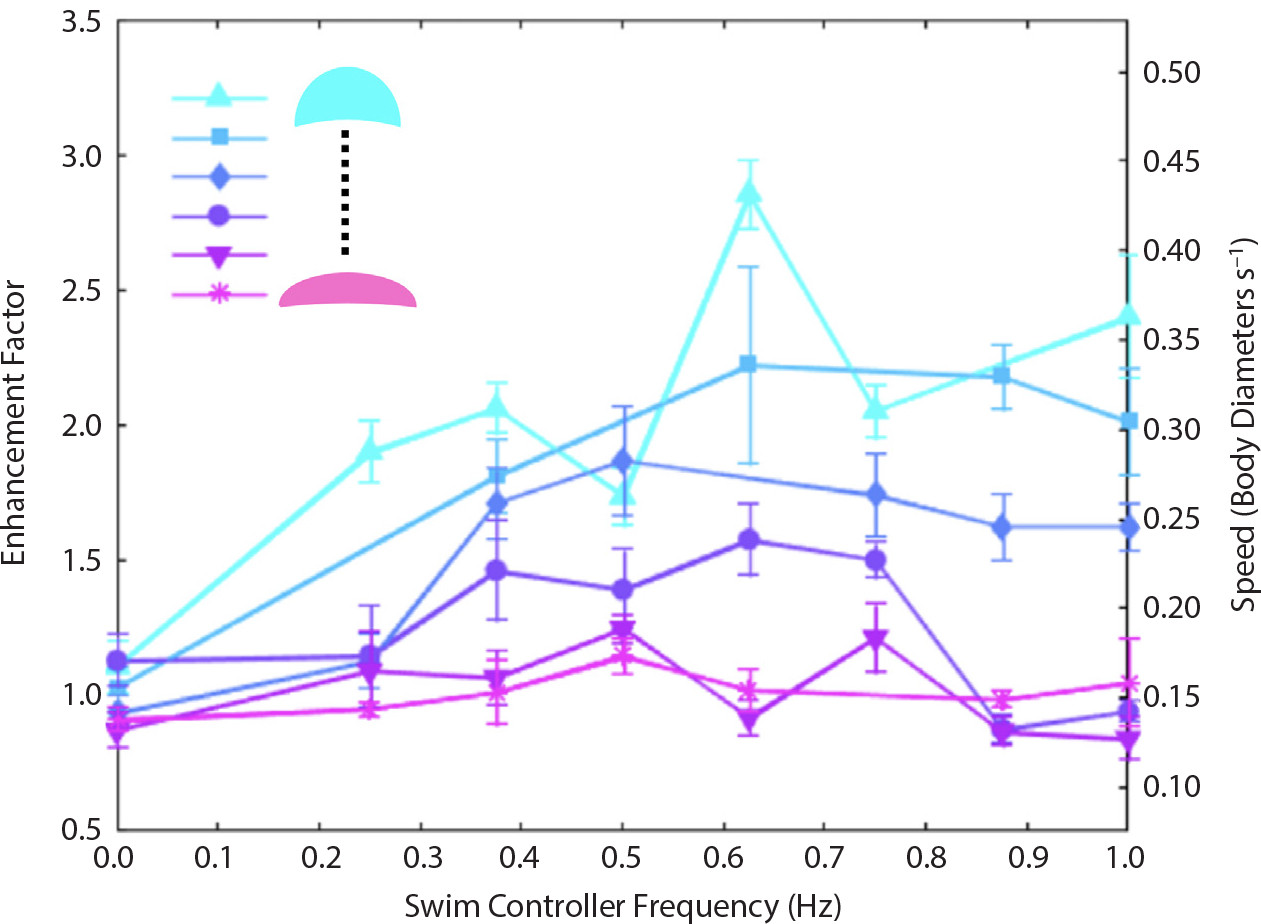
Effigy 7. Pond speeds and enhancement factors for swim controller frequencies up to 1 Hz. Each animal studied is represented by a dissimilar colour bend, and the size range per creature reflects changes in bong growth over time (experiments were conducted over several days). Normalized speeds (body diameters per 2nd) are indicated on the right ordinate axis. The enhancement factor is defined as the normalized swimming speed scaled by the mean of the normalized 0 Hz speed (i.e., in the absence of stimulation, in which the swim controller is embedded but inactive). From Xu and Dabiri (2020). > High res effigy
Interestingly, these externally driven jellyfish were also plant to swim with amend energy efficiency as well, as measured by their metabolic requirements and the COT metric. Specifically, the bio-hybrid jellyfish robots were observed to swim up to three times faster than their natural counterparts at only twice the energetic cost to the animal. For the same swimming efficiency as the natural counterparts, the energetic cost of pond at triple the speed would correspond to a 9-fold increase in COT. Hence, robotic control revealed latent swimming operation that the jellies exercise not showroom naturally. We can reconcile these observations past noting that this species of jellyfish is primarily a filter feeder. Its swimming is secondary to the function of drawing surrounding water (and suspended casualty) toward its feeding appendages. Neither swimming speed nor swimming efficiency is necessarily a priority for these organisms in nature, compared to survivability of the individual and evolutionary fettle of the species. However, for our engineering applications, those characteristics tin potentially exist exploited to achieve the goal of global ocean exploration. Indeed, the external power consumption of these bio-hybrid robotic jellyfish is 10 to 1,000 times less than that of existing underwater robots, including bio-inspired robots and more traditional underwater vehicles (Xu and Dabiri, 2020). Initial field trials of the robotically controlled jellyfish have also demonstrated that the system described here tin be deployed in the real bounding main, with similar enhanced swimming speeds as observed in the laboratory (see Figure 8c,d for representative images of the setup; Xu et al., 2020).
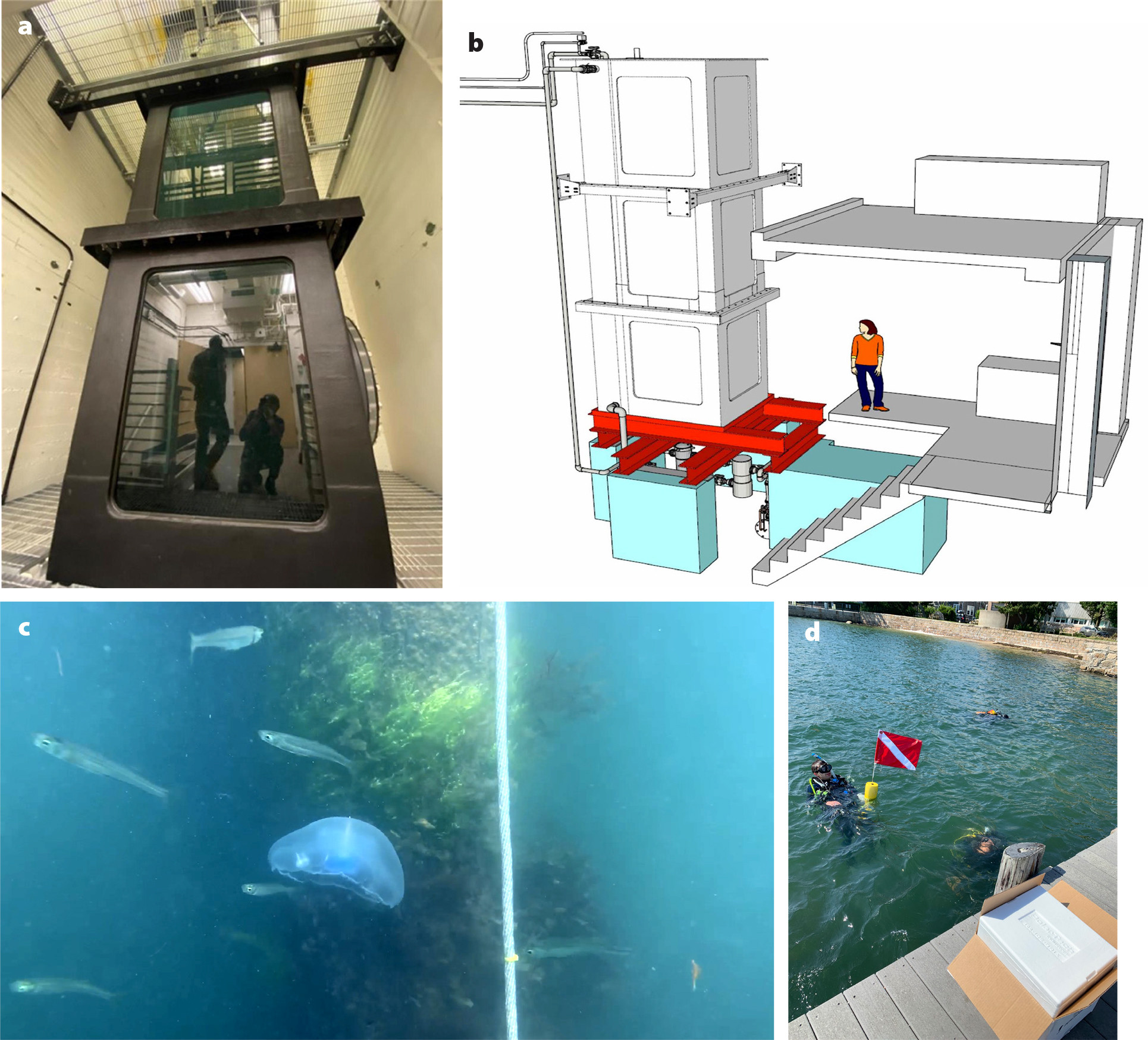
Effigy 8. Test environments for bio-hybrid robotic jellyfish swimming. (a) Laboratory tank (twenty ft height × 5 ft width/length, or 6 chiliad height × 1.5 width/length) with controllable upwelling and downwelling h2o currents for testing jellyfish and bio-robotic swimming in controlled systems. (b) Schematic illustration of the tank to scale. Representative images of (c) a robotically controlled jellyfish pond in an sea surround, monitored by (d) scientific scuba divers off the coast of Woods Hole, Massachusetts. From Xu et al. (2020). > High res figure
The Future of Bio-inspired Ocean Exploration
Although initial field tests yielded promising results, several additional developments are required to create a viable sea sensor. Outset, the robotic control is currently limited to ane-dimensional steering in the direction of the electric current jellyfish heading. Full six degree-of-liberty steering of the jellyfish will probable require more complex musculus stimulation strategies than that implemented to date (Hoover et al., 2021), such as using various asymmetric activation patterns of electrodes on the swim muscle. Disproportionate activation patterns of electrodes can exist used to initiate bell pitching due to torque, such equally by stimulating one electrode to initiate fourth dimension-dependent muscle contractions that travel in a bidirectional moving ridge from the point of electrode contact. Potential control over finer musculus near the bell margin for increased turning maneuvers could also exist used to mimic the animals' natural turning enhancements.
In add-on, the existing command organization is open loop (i.east., the control is not contingent on the current state of the jellyfish, such as its heading or sensed environment). We are excited well-nigh the potential of mutual robotics platforms such every bit Arduino, which can achieve airtight-loop control with express additional system complexity. The goal is for eventual robotic swarms to conduct autonomously. Applications of emerging techniques in artificial intelligence such as reinforcement learning (Gunnarson et al., 2021) can enable robust command with limited onboard computational processing, and physical tests can be performed in a three-story alpine tank with controllable upwelling and downwelling water currents at the California Institute of Engineering science ( Figure 8a,b ).
The utility of the jellyfish sensors ultimately depends on their measurement capabilities. Indeed, the comparing with AUVs is tenuous, given the AUV'southward capability for carrying a much larger payload individually than jellyfish. Groups of robotic jellyfish operating in concert might be able to lucifer functions typically achieved past single, larger systems. Nevertheless, an of import next stride is to demonstrate ocean-relevant measurements using the robotic jellyfish systems. Vertical profiles of body of water physics, chemistry, and biology used for studying temporal and spatial patterns, such as carbon sequestration and food ship, are a promising first application expanse. Such measurements could be a powerful complement to the physical and biogeochemical measurements of the Argo and BGC-Argo projects, and reduce the costs needed to obtain information at college resolutions to study the biogeochemistry of the body of water on a worldwide scale. Large swarms of jellyfish robots also have the potential to amend predictions of ocean climate models. Miniaturized cameras could besides be used to find regions of interest in the body of water that are currently unexplored, such as almost sensitive coral reefs or in abyssal trenches where taxonomic and brute behavioral data is sparse.
We can also take advantage of this bio-inspired system for its innate abilities and physiology. For instance, future projects might use the jellyfish'due south innate sensory information to translate the biological signals received from their sensory organs, or rhopalia, into information that tin can be used for more autonomous behaviors. In addition, the metabolic systems of jellyfish provide considerable untapped potential—new advances could allow these animals to power their own onboard electronics through chemic conversion processes.
Practical implementation of this applied science could exist express by the longevity of jellyfish functioning, and so information technology is important to narrate that limit. Desensitization of robotically stimulated jellyfish muscle, which could return external control ineffective, has not even so been observed. To appointment, laboratory experiments have been conducted over a maximum two-day period to permit the animals to rest and recover. Although successful musculus stimulation appeared consequent during these 48-hour periods, longer-term experiments should be conducted in controlled laboratory environments to decide whether there is observed muscle fatigue, changes in the forcefulness of musculus pulses, and subsequent changes in swimming speeds. These tests can likewise quantify whether the filter feeding capabilities of jellyfish are impacted by robotic control, and if the quantity of nutrient sources available in the water tin can sustain the additional metabolic costs of faster swimming speeds. Additionally, information technology is unclear whether jellyfish that die while deployed in the ocean would be a hindrance to data collection. It might be possible to stimulate their pond muscle for a period mail service-mortem, equally has been demonstrated recently in arachnids with the concept of "necrobotics" (i.e., using robotic systems to stimulate dead organisms; Yap et al., 2022). Equally noted to a higher place, ethical considerations must precede pursuit of these approaches.
Fifty-fifty with ideal results regarding the longevity of individual jellyfish, because the ocean is a complex, unstructured environment for whatsoever robotic system, the longevity of individual robotically controlled jellyfish is unknown due to natural predation. To ensure that lost systems practise non contribute to sea pollution or cause impairment to other organisms, advances in biodegradable electronics (Irimia-Vladu et al., 2012; Li et al., 2018), and either natural materials or biodegradable housing and structural elements, should be pursued to supplant conventional hardware in these systems. Further ethical consideration should exist given to addressing whatever concerns, from the private level for jellyfish test subjects (eastward.one thousand., past continuous monitoring of stress-related molecular biomarkers) to species-wide and ecological levels (e.grand., by considering potential unintended consequences), and then that this new approach is a model for both its technological innovation and its ethical pursuit of research.
Recovery of measurements from the robotic jellyfish faces the same challenges encountered when using existing AUVs. Initial efforts are focused on surface recovery. Rendezvous with complementary systems in Figure 1 could provide another strategy for efficient data recovery. Bio-hybrid robotic jellyfish tin can and should exist used synergistically with these existing technologies in order to complement the strengths and weaknesses of each organization. For example, to address the issue of bio-hybrid robotic jellyfish whose swimming speeds (on the social club of centimeters per second) are slower than those of traditional underwater vehicles (on the lodge of meters per second), expeditions could use AUVs to tow jellyfish swarms to regions of interest and release them to disperse for data drove. This approach could also exist useful for hosting a recharging station for the jellyfish robots on the AUV, or for using existing short-range underwater communication technologies. Finally, considering jellyfish are zooplankton, or metazoans primarily carried by currents in the bounding main, we can potentially use robotic jellyfish as Lagrangian sensors in areas with potent currents, such as the East Australian Electric current, to disperse these swarms over a larger spatial calibration.
Indeed, the use of bio-hybrid robotic jellyfish need not exist as a stand-alone tool for the entire futurity of sea observation. Many of the most pressing global issues or scientifically challenging problems are at the intersection of multiple disciplines. The awarding of remotely controlled jellyfish provides an exciting prospect for such interdisciplinary work. Much like we cannot exist every bit individuals in this world without communities, the global collaborative efforts and challenges of the Un Body of water Decade highlight how synergistic efforts can be used to meliorate understand the ocean and furnishings of climatic change.
Success in this endeavor could enable us to revisit scientific questions that have lain fallow in recent years due to our inability to access the ocean at reasonable costs. The prospect of biogenic ocean mixing in diurnal vertical migrations is an heady instance (Katija and Dabiri, 2009; Houghton et al., 2018). More generally, the low price of this applied science has the potential to democratize body of water exploration and benefit areas that rely more heavily on the ocean economy, including disproportionate numbers of developing nations. The electric current high cost of ship time, on the society of 20,000 USD to l,000 USD per day, creates a structural barrier to wider participation in body of water science. While the loftier toll has the ancillary benefit of promoting collaboration of larger teams in order to pool available resource, information technology tin likewise pb to the exclusion of scientists non affiliated with those groups. More perniciously, it can prevent the exploration of new ideas that have non yet gained acceptance as the dominant paradigm in a field, as experimental ocean science is typically too expensive for a lone investigator testing an unorthodox hypothesis to pursue. Maybe a solution lies in the similarly unorthodox approach summarized in this Revelle Lecture.
Acknowledgments
The authors gratefully acknowledge seminal contributions to this work from a diverse set of students and colleagues, including Kakani Katija, Lydia Ruiz, Robert Whittlesey, Janna Nawroth, Jack Costello, Sean Colin, Monty Graham, Brad Gemmell, Kelly Sutherland, and Kit Parker. Funding from the National Science Foundation, the Part of Naval Research, and the John D. and Catherine T. MacArthur Foundation was essential to conduct this research.
Commendation
References
Biogeochemical-Argo Planning Group. 2016. The Scientific Rationale, Design and Implementation Program for a Biogeochemical-Argo Float Array, 65 pp., https://doi.org/10.13155/46601.
Birch, J. 2017. Animal sentience and the precautionary principle. Animal Sentience xvi(ane), https://doi.org/10.51291/2377-7478.1200.
Broecker, Due west.Southward., T. Takahashi, H.J. Simpson, and T.H. Peng. 1979. Fate of fossil fuel carbon dioxide and the global carbon budget. Science 206:409–418, https://doi.org/x.1126/science.206.4417.409.
Brooke, S., C. Kelley, R.K. Kosaki, M. Parke, F. Parrish, A. Bowman, and J. Potter. 2017. CAPSTONE: Exploring the U.s. marine protected areas in the primal and western Pacific. 2017. Pp. 53–55 in New Frontiers in Ocean Exploration: The E/V Nautilus, NOAA Ship Okeanos Explorer, and R/V Falkor 2016 Field Season. Thousand.L.C. Bell, J. Flanders, A. Bowman, and Northward.A. Raineault, eds. Oceanography thirty(1), supplement, https://doi.org/10.5670/oceanog.2017.supplement.01.
Cai, W.J., Y.Y. Xu, R.A. Feely, R. Wanninkhof, B. Jönsson, Southward.R. Alin, L. Barbero, J.Due north. Cross, K. Azetsu-Scott, A.J. Fassbender, and others. 2020. Controls on surface water carbonate chemistry forth Due north American sea margins. Nature Communications 11:2691, https://doi.org/10.1038/s41467-020-16530-z.
Chapron, B., R. Garello, and D.E. Weissman. 2008. Sea remote sensing: Challenges for the future. OCEANS 2008, conference held September 15–eighteen, 2008, Quebec Metropolis, Canada, https://doi.org/10.1109/OCEANS.2008.5152125.
Claustre, H., Thou.S. Johnson, and Y. Takeshita. 2020. Observing the global ocean with Biogeochemical-Argo. Annual Review of Marine Science 12:23–48, https://doi.org/10.1146/annurev-marine-010419-010956.
Claydon, D. 2006. "Undersea robots dive deeper and market widens to U.Yard. defense ministry." Boston Business Periodical, January thirty, 2006, https://www.bizjournals.com/boston/blog/mass-high-tech/2006/01/undersea-robots-swoop-deeper-and-market-widens.html.
Collard, F., L. Marié, F. Nouguier, M. Kleinherenbrink, F. Ehlers, and F. Ardhuin. 2022. Wind-wave attenuation in Arctic sea ice: A discussion of remote sensing capabilities. Periodical of Geophysical Enquiry: Oceans 127:e2022JC018654, https://doi.org/10.1029/2022JC018654.
Copley, J. 2014. "Simply how footling do we know about the ocean floor?" The Conversation, October ix, 2014, https://theconversation.com/merely-how-little-do-we-know-well-nigh-the-ocean-floor-32751.
Costello, J.H., S.P. Colin, J.O. Dabiri, B.J. Gemmell, Grand.N. Lucas, and Grand.R. Sutherland. 2021. The hydrodynamics of jellyfish pond. Almanac Review of Marine Science 13:375–396, https://doi.org/10.1146/annurev-marine-031120-091442.
Dabiri, J.O., and Thou. Gharib. 2005. The role of optimal vortex formation in biological fluid transport. Proceedings of the Majestic Order B: Biological Sciences 272:1,557–1,560, https://doi.org/10.1098/rspb.2005.3109.
Dabiri, J.O. 2009. Optimal vortex formation as a unifying principle in biological propulsion. Annual Review of Fluid Mechanics 41:17–33, https://doi.org/x.1146/annurev.fluid.010908.165232.
Dabiri, J.O. 2011. Potential guild-of-magnitude enhancement of air current farm power density via counter-rotating vertical-centrality wind turbine arrays. Journal of Renewable and Sustainable Free energy 3:043104, https://doi.org/10.1063/1.3608170.
Dabiri, J.O., S. Bose, B.J. Gemmell, South.P. Colin, and J.H. Costello. 2014. An algorithm to approximate unsteady and quasi-steady pressure fields from velocity field measurements. Journal of Experimental Biology 217:331–336, https://doi.org/ten.1242/jeb.092767.
DeVries, T., C. Le Quere, O. Andrews, South. Berthet, J. Hauck, T. Ilyina, P. Landschützer, A. Lenton, I.D. Lima, Yard. Nowicki, and others. 2019. Decadal trends in the body of water carbon sink. Proceedings of the National Academy of Sciences of the United states of america of America 116(24):eleven,646–11,651, https://doi.org/10.1073/pnas.1900371116.
De Waal, F.B.Grand., and K. Andrews. 2022. The question of animal emotions. Science 375:1,351–1,352, https://doi.org/10.1126/science.abo2378.
Egleston, E.Southward., C.L. Sabine, and F.G.M. Morel. 2010. Revelle revisited: Buffer factors that quantify the response of ocean chemical science to changes in DIC and alkalinity. Global Biogeochemical Cycles 24(1), https://doi.org/10.1029/2008GB003407.
Feinberg, A.W., A. Feigel, S.S. Shevkoplyas, S. Sheehy, Grand.M. Whitesides, and K.Thousand. Parker. 2007. Muscular thin films for building actuators and powering devices. Science 317:ane,366–1,370, https://doi.org/x.1126/scientific discipline.1146885.
Frame, J., North. Lopez, O. Curet, and East.D. Engeberg. 2018. Thrust forcefulness label of free-swimming soft robotic jellyfish. Bioinspiration & Biomimetics xiii:064001, https://doi.org/10.1088/1748-3190/aadcb3.
Fregoso, T.A., and B.E. Jaffe. 2020. Pilot study on bathymetric change analyses in the Sacramento-San Joaquin Delta, California. US Geological Survey data release, https://doi.org/10.5066/P976WNNN.
Gemmell, B.J., J.H. Costello. S.P. Colin, C. Stewart, J.O. Dabiri, D. Tafti, and Due south. Priya. 2013. Passive free energy recapture in jellyfish contributes to propulsive advantage over other metazoans. Proceedings of the National Academy of Sciences of the United States of America 110(44):17,904–17,909, https://doi.org/10.1073/pnas.1306983110.
Gemmell, B.J., J.H. Costello, S.P. Colin, and J.O. Dabiri. 2015. Suction-based propulsion as a basis for efficient animal swimming. Nature Communications 6:8790, https://doi.org/ten.1038/ncomms9790.
Gharib, M., E. Rambod, A. Kheradvar, D.J. Sahn, and J.O. Dabiri. 2006. Optimal vortex formation as an index of cardiac health. Proceedings of the National Academy of Sciences of the United states of america of America 103(16):6,305–6,308, https://doi.org/10.1073/pnas.0600520103.
Gillsater, B. 2018. "The potential of the blue economic system." World Banking company Blogs, July 30, 2018, https://blogs.worldbank.org/voices/potential-blue-economy.
Gish, L.A. 2004. Design of an AUV Recharging Arrangement. Naval Engineer and Main's Thesis, Massachusetts Institute of Technology, Section of Ocean Engineering, 134 pp., http://hdl.handle.net/1721.1/33445.
Gunnarson, P.J., I. Mandralis, G. Novati, P. Koumoutsakos, and J.O. Dabiri. 2021. Learning efficient navigation in vortical period fields. Nature Communications 12:7143, https://doi.org/x.1038/s41467-021-27015-y.
Hoover, A.P., North.W. Xu, B.J. Gemmell, S.P. Colin, J.H. Costello, J.O. Dabiri, and 50. Miller. 2021. Neuromechanical wave resonance in jellyfish pond. Proceedings of the National University of Sciences of the U.s.a. of America 118(11):e2020025118, https://doi.org/10.1073/pnas.2020025118.
Houghton, I.A., J.R. Koseff, S.One thousand. Monismith, and J.O. Dabiri. 2018. Vertically migrating swimmers generate aggregation-calibration eddies in a stratified column. Nature 556:497–500, https://doi.org/10.1038/s41586-018-0044-z.
Humphreys, M.P., E.R. Lewis, J.D. Sharp, and D. Pierrot. 2022. PyCO2SYS v1.8: Marine carbonate system calculations in Python. Geoscientific Model Evolution 15:15–43, https://doi.org/x.5194/gmd-fifteen-xv-2022.
Irimia-Vladu, M., E.D. Glowacki, G. Voss, S. Bauer, and Due north.S. Sariciftci. 2012. Green and biodegradable electronics. Materials Today 15:340–346, https://doi.org/10.1016/S1369-7021(12)70139-6.
Katija, Yard., and J.O. Dabiri. 2008. In situ field measurements of aquatic animal-fluid interactions using a self-contained underwater velocimetry apparatus (SCUVA). Limnology and Oceanography: Methods 6:162–171, https://doi.org/10.4319/lom.2008.6.162.
Katija, K., and J.O. Dabiri. 2009. A viscosity-enhanced mechanism for biogenic body of water mixing. Nature 460:624–626, https://doi.org/10.1038/nature08207.
Katija, One thousand., W.T. Beaulieu, C. Regula, Due south.P. Colin, J.H. Costello, and J.O. Dabiri. 2011. Quantification of flows generated by the hydromedusa Aequorea victoria: A Lagrangian coherent construction (LCS) analysis. Marine Environmental Progress Series 435:111–123, https://doi.org/ten.3354/meps09212.
Kavanaugh, Chiliad.T., T. Bell, D. Catlett, M.A. Cimino, S.C. Doney, W. Klajbor, Grand. Messié, E. Montes, F.E. Muller-Karger, D. Otis, and others. 2021. Satellite remote sensing and the Marine Biodiversity Observation Network: Current science and future steps. Oceanography 34(2):62–79, https://doi.org/ten.5670/oceanog.2021.215.
Lee, K.Y., Due south.J. Park, D.M. Matthews, S.Fifty. Kim, C.A. Marquez, J.F. Zimmerman, H.A.M. Ardoña, A.G. Kleber, One thousand.V. Lauder, and K.K. Parker. 2022. An autonomously swimming biohybrid fish designed with human cardiac biophysics. Science 375:639–647, https://doi.org/10.1126/science.abh0474.
Li, R., L. Wang, D. Kong, and 50. Yin. 2018. Recent progress on biodegradable materials and transient electronics. Bioactive Materials three(3):322–333, https://doi.org/10.1016/j.bioactmat.2017.12.001.
Mayer, L., M. Jakobsson, Yard. Allen, B. Dorschel, R. Falconer, V. Ferrini, Thou. Lamarche, H. Snaith, and P. Weatherall. 2018. The Nippon Foundation–GEBCO Seabed 2030 Projection: The quest to see the world's oceans completely mapped by 2030. Geosciences 8(2):63, https://doi.org/ten.3390/geosciences8020063.
Megill, Westward.M., J.Thou. Gosline, and R.W. Blake. 2005. The modulus of elasticity of fibrillin-containing elastic fibers in the mesoglea of the hydromedusa Polyorchis penicillatus. Journal of Experimental Biology 208:iii,819–three,834, https://doi.org/10.1242/jeb.01765.
Mora, C., D.P. Tittensor, South. Adl, A.G.B. Simpson, and B. Worm. 2011. How many species are there on Earth and in the ocean? PLoS Biological science nine(8):e1001127, https://doi.org/10.1371/periodical.pbio.1001127.
NASA Science: Share the Scientific discipline. 2022. Living Body of water, https://science.nasa.gov/earth-science/oceanography/living-ocean.
NASEM (National Academies of Sciences, Engineering, and Medicine). 2022. Cross-Cut Themes for United states Contributions to the United nations Sea Decade. The National Academies Printing, Washington, DC, 142 pp., https://doi.org/ten.17226/26363.
Nawroth, J.C., H. Lee, A.W. Feinberg, C.M. Ripplinger, M.Fifty. McCain, A. Grosberg, J.O. Dabiri, and K.K. Parker. 2012. A tissue-engineered jellyfish with biomimetic propulsion. Nature Biotechnology 30:792–797, https://doi.org/ten.1038/nbt.2269.
Novaczek, E., R. Devillers, and E. Edinger. 2019. Generating higher resolution regional seafloor maps from crowd-sourced bathymetry. PLoS ONE 14(six):e0216792, https://doi.org/10.1371/journal.pone.0216792.
NRC (National Research Council). 1959. Oceanography 1960 to 1970: A Written report of the Committee on Oceanography of the National Academy of Sciences. Chapter 6, "New Research Ships," The National Academies Printing, Washington, DC, https://nap.nationalacademies.org/catalog/20222/oceanography-1960-1970-chapter-6-new-enquiry-ships.
OECD (Organization for Economic Co-operation and Development). 2020. Sustainable Ocean for All: Harnessing the Benefits of Sustainable Bounding main Economies for Developing Countries. OECD Publishing, Paris, 173 pp., https://doi.org/10.1787/bede6513-en.
O'Rourke, R. 2022. Navy Large Unmanned Surface and Undersea Vehicles: Background and Problems for Congress. Congressional Inquiry Service, R45757, 38 pp., https://sgp.fas.org/crs/weapons/R45757.pdf.
Folio, B.R., S. Ziaeefard, A.J. Pinar, and Northward. Mahmoudian. 2017. Highly maneuverable depression-cost underwater glider: Design and development. IEEE Robotics and Automation Letters 2(1):344–349, https://doi.org/10.1109/LRA.2016.2617206.
Purcell, J., E. Baxter, and 5. Fuentes. 2013. Jellyfish as products and bug of aquaculture. Pp. 404–430 in Advances in Aquaculture Hatchery Applied science. G. Allan and Thou. Burnell, eds, Woodhead Publishing, https://doi.org/10.1533/9780857097460.ii.404.
Reaka-Kudla, K.50. 2001. Known and unknown biodiversity, take a chance of extinction and conservation strategy in the sea. Pp. 19–33 in Waters in Peril. L. Bendell-Young and P. Gallaugher, eds, Springer, Boston, MA, https://doi.org/10.1007/978-1-4615-1493-0_2.
Revelle, R., and H.E. Suess. 1957. Carbon dioxide exchange betwixt atmosphere and ocean and the question of an increase of atmospheric CO2 during the past decades. Tellus nine:18–27, https://doi.org/10.3402/tellusa.v9i1.9075.
Roemmich, D., G.C. Johnson, S. Riser, R. Davis, J. Gilson, Westward.B. Owens, S.L. Garzoli, C. Schmid, and M. Ignaszewski. 2009. The Argo Programme: Observing the global ocean with profiling floats. Oceanography 22(2):34–43, https://doi.org/x.5670/oceanog.2009.36.
Ruiz, L.A., R.W. Whittlesey, and J.O. Dabiri. 2011. Vortex-enhanced propulsion. Journal of Fluid Mechanics 668:5–32, https://doi.org/10.1017/S0022112010004908.
Sabine, C.Fifty., H. Ducklow, and M. Hood. 2010. International carbon coordination: Roger Revelle's legacy in the Intergovernmental Oceanographic Commission. Oceanography 23(3):48–61, https://doi.org/10.5670/oceanog.2010.23.
Shintake, J., H. Sonar, E. Piskarev, J. Paik, and D. Floreano. 2017. Soft pneumatic gelatin actuator for edible robotics. Pp. 6,221–6,226 in 2017 IEEE/RSJ International Conference on Intelligent Robots and Systems (IROS), https://doi.org/10.1109/IROS.2017.8206525.
Sneddon, 50.U. 2018. Comparative physiology of nociception and pain. Physiology 33(one):63–73, https://doi.org/10.1152/physiol.00022.2017.
Steele, J., S. Thorpe, and K. Turekian. 2009. Encyclopedia of Bounding main Sciences. Academic Printing, San Diego, CA.
Teeneti, C.R., T.T. Truscott, D.N. Beal, and Z. Pantic. 2021. Review of wireless charging systems for autonomous underwater vehicles. IEEE Periodical of Oceanic Technology 46(one):68–87, https://doi.org/ten.1109/JOE.2019.2953015.
Thomson, J., S. Ackley, H.H. Shen, and W.E. Rogers. 2017. The balance of water ice, waves, and winds in the Arctic autumn. Eos 98, https://doi.org/10.1029/2017EO066029.
Villanueva, A., C. Smith, and South. Priya. 2011. A biomimetic robotic jellyfish (Robojelly) actuated by shape memory allows composite actuators. Bioinspiration & Biomimetics half dozen:036004, https://doi.org/10.1088/1748-3182/half-dozen/3/036004.
Whittlesey, R.W., S.C. Liska, and J.O. Dabiri. 2010. Fish schooling as a basis for vertical-axis wind turbine subcontract pattern. Bioinspiration and Biomimetics five:035005, https://doi.org/10.1088/1748-3182/5/iii/035005.
Whittlesey, R.W., and J.O. Dabiri. 2013. Optimal vortex formation in a self-propelled vehicle. Journal of Fluid Mechanics 737:78–104, https://doi.org/ten.1017/jfm.2013.560.
WoRMS Editorial Board. 2022. World Register of Marine Species. Available from https://doi.org/ten.14284/170, accessed August 31, 2022.
Xu, N.W., and J.O. Dabiri. 2020. Low-ability microelectronics embedded in live jellyfish enhance propulsion. Scientific discipline Advances 6:eaaz3194, https://doi.org/10.1126/sciadv.aaz3194.
Xu, N.W., J.P. Townsend, J.H. Costello, S.P. Colin, B.J. Gemmell, and J.O. Dabiri. 2020. Field testing of biohybrid robotic jellyfish to demonstrate enhanced swimming speeds. Biomimetics 5(iv):64, https://doi.org/10.3390/biomimetics5040064.
Xu, N.Due west., O. Lenczewska, S.Eastward. Wieten, C.A. Federico, J.O. Dabiri. 2022. Ethics of biohybrid robotic jellyfish modification and invertebrate research. Preprints.org, https://doi.org/10.20944/preprints202010.0008.v1.
Yap, T.F., Z. Liu, A. Rajappan, T.J. Shimokusu, and D.J. Preston. 2022. Necrobotics: Biotic materials as set up-to-apply actuators. Advanced Science 2201174, https://doi.org/10.1002/advs.202201174.
Copyright & Usage
This is an open admission article made available under the terms of the Creative Commons Attribution 4.0 International License (https://creativecommons.org/licenses/past/4.0/), which permits use, sharing, accommodation, distribution, and reproduction in any medium or format as long as users cite the materials appropriately, provide a link to the Creative Eatables license, and indicate the changes that were fabricated to the original content. Images, animations, videos, or other third-party material used in articles are included in the Artistic Commons license unless indicated otherwise in a credit line to the material. If the material is not included in the article's Creative Commons license, users volition need to obtain permission direct from the license holder to reproduce the material.

Ocean Exploration Is Limited By,
Source: https://tos.org/oceanography/article/bio-inspired-ocean-exploration
Posted by: wyckoffsupuldn.blogspot.com
0 Response to "Ocean Exploration Is Limited By"
Post a Comment